Call Us 24/7


Tajikistan is a mountainous country in Central Asia, renowned for its spectacular landscapes, ancient Silk Road heritage and rich Persian-influenced culture. It shares borders with Uzbekistan, Kyrgyzstan, China and Afghanistan.
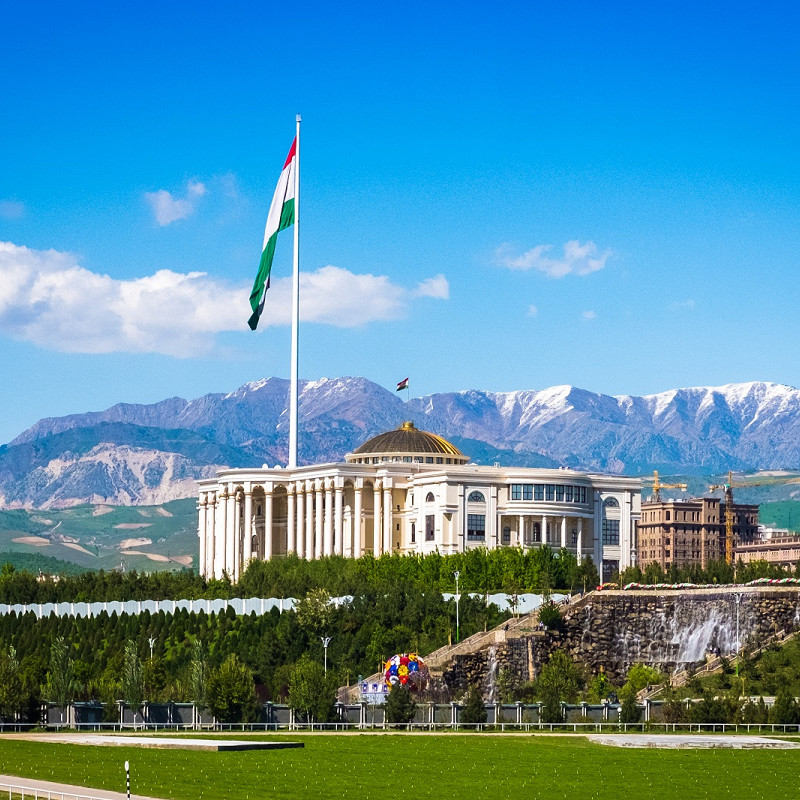
The capital, Dushanbe, is a welcoming city with broad avenues, green parks, museums, colourful bazaars and impressive cultural landmarks. Among its notable attractions are Rudaki Park, the National Museum of Tajikistan and the magnificent Navruz Palace.
More than ninety percent of Tajikistan is covered by mountains. The country’s most remarkable natural destinations include the Pamir Mountains, the legendary Pamir Highway, the turquoise Iskanderkul Lake, the Fann Mountains and the beautiful Seven Lakes. These areas attract travellers interested in trekking, mountaineering, photography and adventurous road trips.
Tajik culture is reflected in traditional music, colourful clothing, handicrafts, national cuisine and warm hospitality. A journey through Tajikistan offers an unforgettable combination of majestic mountains, ancient history, authentic traditions and unspoiled nature.
Dushanbe is the capital and largest city of Tajikistan. Its name means “Monday” in Persian, as the city developed on the site of a Monday market. For centuries, it remained a small village. However, following the Bolshevik Revolution and the conquest of Central Asia by the Red Army, it became the capital of the newly established Tajik Autonomous Soviet Socialist Republic and later the Tajik Soviet Socialist Republic. Under Soviet rule, Dushanbe grew rapidly and acquired numerous industrial enterprises and cultural institutions. The city was peaceful and prosperous, with a highly diverse population due to the arrival of workers—mostly Russian-speaking—from other parts of the Soviet Union. Today, its population is around 850,000. During the 1990s, Dushanbe fell into decline, and its residents became impoverished following the collapse of the Soviet planned economy and the Tajik Civil War of 1992–1997. Most Russians and members of other ethnic minorities left the country during this period. Over the past decade, however, the city has experienced a remarkable revival and has become more prosperous and attractive than ever. Much of its infrastructure has been rebuilt: streets have been resurfaced and improved, while electricity, water and gas supplies are reliable. Gleaming new hotels and banks are now common, as are internet cafés, well-stocked supermarkets and modern apartment buildings. In the city centre, visitors can find almost every variety of international cuisine, ranging from affordable and authentic Uzbek and Central Asian dishes to excellent European, Asian and American offerings. Modern Dushanbe is a genuine “garden city.” Its broad boulevards and quiet side streets, lined with tall plane trees and poplars, create the impression of a green oasis during the hot summer months. Numerous large parks are scattered throughout the city and irrigated by an extensive network of canals and waterways of various sizes. Accommodation ranges from one- to five-star establishments, including quiet guesthouses in historic buildings and cosmopolitan business hotels operated by international chains such as Radisson and Hyatt.
Istaravshan, Tajikistan, is one of the oldest cities in the world and celebrated its 2,500th anniversary in 2002. With a population of approximately 65,000, the city is strategically situated on the road connecting Dushanbe with the regional capital, Khujand. Throughout its long history, Istaravshan has witnessed the rise and fall of countless rulers and empires, each contributing to the formation of the resilient and tradition-rich city it is today. Located in northern Tajikistan at the foothills of the Turkestan Range, the city stands at an altitude of almost 1,000 metres above sea level. It has a mild climate, with snowy winters and dry, cool summers. The area borders Uzbekistan to the north and west, the Ghonchi District to the east, Kyrgyzstan to the southeast and Tajikistan’s Ayni District to the south. The city was first founded between the 6th and 5th centuries BC by the Persian king Cyrus. It was originally known as Cyropolis, a name derived from Cyrus. The city owed its early development partly to the growth of handicraft production and regional trade. By the time Alexander the Great conquered Central Asia in the 4th century BC, Cyropolis was already a large and well-fortified city. It was at the walls of Cyropolis that Alexander the Great was wounded for the first time.
Khujand, also transliterated as Khudzhand, Khojand or Khodjent, was known as Khodjent until 1939 and as Leninabad (Leninobod) until 1992. It is the second-largest city in Tajikistan. The city lies on both banks of the Syr Darya River at the entrance to the Fergana Valley. Its population is approximately 150,000, slightly lower than the 160,000 recorded in 1989. Khujand is also the capital of Tajikistan’s northernmost region, now known as the Sughd Region. The city occupies a strategically important position at the narrow western end of the Fergana Valley and is almost entirely surrounded by Uzbekistan. It is connected to the rest of Tajikistan by the Khujand–Dushanbe Highway, a challenging high-altitude route that was traditionally closed during winter. As of 2009, a complete reconstruction of this road, together with the construction of several new tunnels by Chinese companies, was nearing completion.
Panjakent, also spelled Penjikent, is a modern city in the far north-west of Tajikistan. It lies in a broad valley at the foothills of the Fann Mountains, close to the border with Uzbekistan. The area is also home to an ancient citadel, one of the oldest in Central Asia, whose ruins stand on a high plateau overlooking the present-day city. The region has always been important because of its strategic location along the Zarafshan River valley. With a population of approximately 35,000, Panjakent is a regional centre of trade and transport. The main route connecting the major cities of Uzbekistan and Tajikistan passes through it. Most local residents work in agriculture and commerce. The lowlands surrounding Panjakent form a highly fertile agricultural region where grapes, cotton and various vegetables are cultivated. Located near Samarkand, across the border, as well as the Fann Mountains and the Fergana Valley, the region is one of the areas of Tajikistan most frequently visited by international travellers. It is also an ideal starting point for hiking and mountaineering expeditions. From almost anywhere in the city, visitors can enjoy magnificent views of the picturesque peaks of the Pamir-Alay mountain system to the south and east. The city’s main attractions include its colourful bazaar and the ruins of ancient Panjakent. Nearby sights include the famous Seven Lakes; the picturesque village of Mazari Sharif, with the mausoleums of Islamic scholars, including Muhammad Bashoro; and the village of Panjrud, the birthplace of the celebrated Persian poet and national hero Rudaki, who lived in the 9th–10th centuries AD.
If the Fann Mountains are the pearl of Tajikistan’s natural beauty, then the Seven Lakes are the diamond necklace adorning their snow-covered cliffs. Also known as the Haft Kul Lakes and the Marguzor Lakes, these glittering bodies of water lie along the winding valley of the Shing River and enchant everyone fortunate enough to see them. Renowned for their strikingly blue waters and surrounding mountain scenery, which is especially beautiful in summer, the Seven Lakes remain one of Tajikistan’s best-kept secrets and receive comparatively few visitors each year.
Murghab is a small mountain town with a population of approximately 4,000, situated on the Murghab Plateau in eastern Tajikistan’s Gorno-Badakhshan Autonomous Region. The town stands at the junction of the Pamir Highway, which passes through its centre and connects the region with Kyrgyzstan and Afghanistan, and the main road linking Tajikistan with China via the Kulma Pass. Because of its strategic location, Murghab was established during the Soviet period as a military outpost. Today, it is an important transport hub and the largest town in the eastern part of Gorno-Badakhshan. Most of its residents are ethnic Kyrgyz, although they live in houses more typical of Tajik communities. In recent years, Murghab has developed into an important tourist centre and is one of the few places in Tajikistan with established tourism infrastructure, including a community-based tourism network.
Gallery
Discover some of our finest work captured through visuals
Testimonials

Moscow, Russia

I was impressed by the friendly service and attention to detail. The itinerary was carefully planned, making our family holiday comfortable and truly memorable.

Istanbul, Türkiye
This was my first booking with Gayrat travel, and the experience exceeded my expectations. The staff were polite, helpful and responsive. Everything was well organised from beginning to end.

London, United Kingdom
The Gayrat travel team organised my journey professionally and answered all my questions promptly. Everything went smoothly, and I felt supported throughout the trip.

Dubai, United Arab Emirates
Gayrat travel helped me choose a tour that matched my schedule and budget. Communication was clear, and every arrangement was completed on time. I highly recommend their services.

Yaoundé, Cameroon
Gayrat travel made my travel experience easy and enjoyable. The team was friendly, attentive and always ready to help. Every detail was organised professionally, and I felt supported throughout the entire journey.
We take care of every detail so you can travel with confidence and ease.

Call Us 24/7
Gayrat Travel © All Rights Reserved.