Call Us 24/7


Kazakhstan is the largest country in Central Asia and the ninth-largest country in the world. It is renowned for its vast steppes, dramatic mountains, clear lakes, modern cities and rich nomadic heritage. Kazakhstan shares borders with Russia, China, Kyrgyzstan, Uzbekistan and Turkmenistan, while its western territory reaches the Caspian Sea.
The capital, Astana, is known for its futuristic architecture, impressive monuments and contemporary cultural centres. Almaty, the country’s largest city, lies at the foot of the snow-capped Trans-Ili Alatau Mountains and attracts visitors with its leafy streets, museums, cafés and vibrant cultural atmosphere.
Kazakhstan offers many remarkable natural attractions, including Charyn Canyon, the colourful lakes of Kolsai and Kaindy, Altyn-Emel National Park, the singing dunes and the mountain landscapes surrounding Almaty. The ancient city of Turkistan, with the Mausoleum of Khoja Ahmed Yasawi, reflects the country’s important historical and spiritual heritage.
Kazakh culture is deeply connected to nomadic traditions, horse riding, traditional music, handicrafts, national cuisine and warm hospitality. A journey through Kazakhstan combines spectacular nature, Silk Road history, authentic traditions and modern urban life.
Almaty is located in southeastern Kazakhstan and has a population of approximately 1.5 million people. Despite losing its status as the capital, Almaty remains one of Central Asia’s largest financial, economic and cultural centres. The city is home to numerous business centres, theatres, museums, art galleries and exhibition halls, as well as countless modern entertainment venues, including state-of-the-art cinemas, casinos, nightclubs, parks, restaurants and cafés. Almaty served as the capital of Kazakhstan from 1929 to 1998. Situated in the foothills of the Trans-Ili Alatau Mountains, it is considered one of the most beautiful cities in the country.
Aktau is the administrative centre of Mangystau, a desert region in southwestern Kazakhstan. Located on the shores of the Caspian Sea, this port city is the centre of Kazakhstan’s oil and gas industry and a starting point for adventure tours across Mangystau. Aktau was founded in the mid-20th century on barren land following the discovery of rich uranium deposits nearby. Since then, it has developed into a vibrant modern city.
Aktobe is an industrial city, and its location south of the southern tip of the Ural Mountains, at Europe’s easternmost edge, may not seem particularly exciting. Geographers do not entirely agree on Europe’s exact boundaries. However, a widely accepted view is that the border runs through Kazakhstan from Aktobe to the Emba River, then westwards towards the Caspian Sea before continuing through Azerbaijan, Armenia and Georgia on its way to the Black Sea.
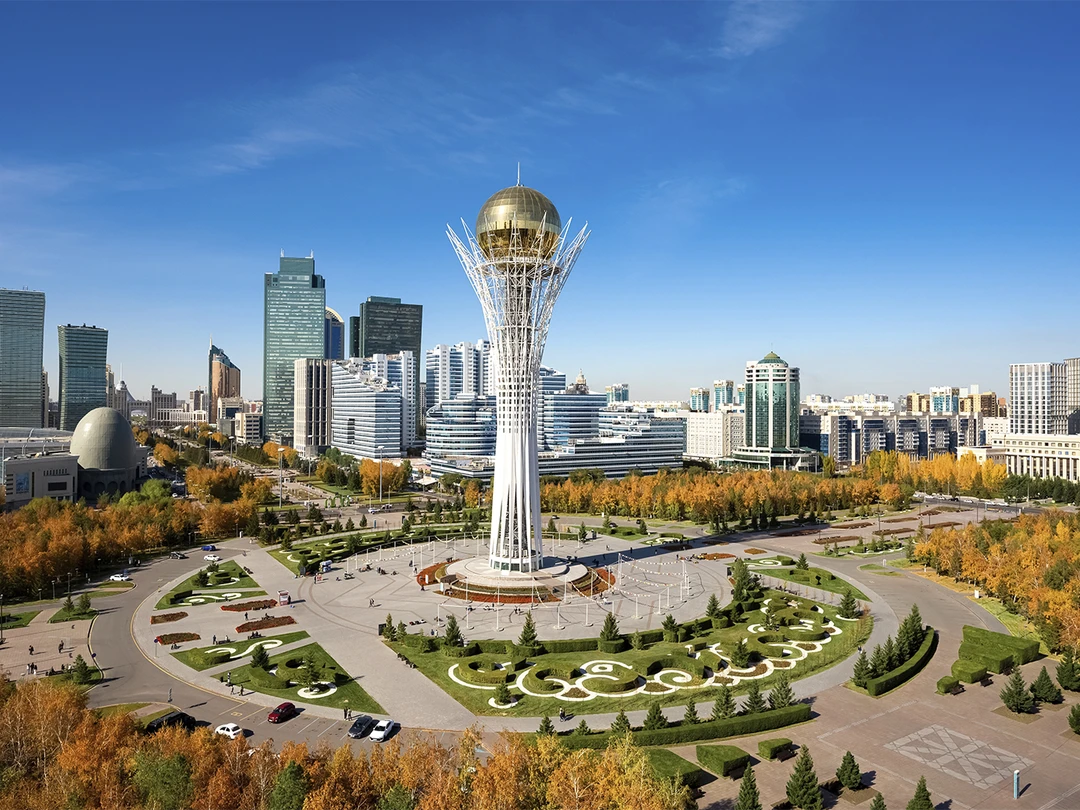
Astana, the capital of the Republic of Kazakhstan since 1997, is situated on the picturesque banks of the Ishim River. The city of Akmolinsk received municipal status in 1862 and was long renowned for its fairs, which attracted merchants from all regions of Kazakhstan, Russia and Central Asia. With the beginning of the Virgin Lands Campaign, the city was renamed Tselinograd and became a typical administrative centre of an agricultural region. Since gaining capital status, its appearance has changed dramatically. Architects and builders working in the capital have created magnificent architectural ensembles that harmoniously combine modern design with Eastern character. The Baiterek Tower has become the symbol and landmark of the city. The structure is 105 metres high. At a height of 97 metres, there is an observation deck offering panoramic views of Astana. The number 97 was not chosen by chance: it symbolises the year in which the capital was transferred from Almaty to Astana. Baiterek Tower also houses an art gallery, a large aquarium and a restaurant.
Atyrau, known as Guryev during the Soviet era, is a city in Kazakhstan and the administrative centre of the Atyrau Region. It is located approximately 2,700 kilometres west of Almaty and 350 kilometres east of the Russian city of Astrakhan. Other transliteration variants include Aterau, Atirau, Atyraw, Atirav and Atirau. Modern Atyrau is known for its oil production and fishing industries. According to 2007 data, the city had a population of 154,100, compared with 142,500 recorded in the 1999 census. Ethnic Kazakhs accounted for 90% of the population, up from 80% previously. The remainder consisted mainly of Russians and representatives of other ethnic groups, including Tatars and Ukrainians. Salimzhan Nakpayev has served as the city’s mayor since October 2006.
Shymkent is a major city in southern Kazakhstan and one of the country’s most populous urban centres. With one of Kazakhstan’s largest metropolitan areas, it is an important railway junction on the Turkestan–Siberian Railway, a renowned cultural centre and home to an international airport. The city lies approximately 690 kilometres west of Almaty and 120 kilometres north of Tashkent, Uzbekistan. Shymkent was founded in the 12th century as a caravanserai on the Silk Road, serving the ancient city of Sayram, located about 10 kilometres to the east. It subsequently developed into an important centre of trade between nomadic and settled communities. Over the centuries, the city was repeatedly destroyed during invasions and military conflicts. Once part of the Kokand Khanate, it came under the control of the Emirate of Bukhara in 1810 and was annexed by the Russian Empire in 1864. In 1914, the city was renamed Chernyaev, and in 1924, it became known as Chimkent.
Elegant decoration, patterned vaults and colourful majolica tiles captivate the imagination. With a history spanning 1,500 years, Turkestan gained fame through the teachings of the renowned Sufi sheikh, distinguished poet and humanist Khoja Ahmed Yasawi, also known as Hazret Sultan. At that time, the city was called Yasi. The theological school founded by Yasawi attracted seekers of knowledge from neighbouring cities and the distant steppes of Kazakhstan. Consequently, the city became one of the country’s most important centres of learning. The memorial complex that developed around Yasawi’s tomb became one of Central Asia’s most visited pilgrimage sites. At the end of the 14th century, Turkestan acquired a unique architectural monument: an extensive complex centred on the Mausoleum of Khoja Ahmed Yasawi, commissioned by the great Timur. In the Muslim world, the mausoleum is regarded as the “Second Mecca.” The enormous building, which has survived numerous historical upheavals and was recently reopened after restoration, stands approximately 40 metres high. The mausoleum is a magnificent complex of palatial and religious spaces, comprising more than 30 rooms and halls. Its main dome measures 22 metres in diameter. The refined ornamentation, patterned ceiling arches and colourful majolica mosaics are truly impressive. A distinctive museum-pantheon has been established in its central hall, which served as the covered residence of the Kazakh khans. The highlight of its collection is the Taiqazan—the largest cast water vessel in the entire Muslim East—made from an alloy of seven metals. The Azret Sultan Historical and Cultural Reserve includes the ancient settlements of Turkestan and Kultobe, a necropolis, mausoleums dating from the 15th–17th centuries, the 19th-century Juma Mosque, the restored Great Hilvet of the 12th century, a 14th-century chillakhana used for rituals and prayers, baths dating from the 17th–19th centuries, and a section of the original 19th-century citadel wall with gates dating from the 18th–19th centuries. Of the 802 historical and cultural monuments in the South Kazakhstan Region, 528 are archaeological sites, 42 are historical monuments and 226 are architectural monuments.
Gallery
Discover some of our finest work captured through visuals
Testimonials

Moscow, Russia

I was impressed by the friendly service and attention to detail. The itinerary was carefully planned, making our family holiday comfortable and truly memorable.
Istanbul, Türkiye
This was my first booking with Gayrat travel, and the experience exceeded my expectations. The staff were polite, helpful and responsive. Everything was well organised from beginning to end.

London, United Kingdom
The Gayrat travel team organised my journey professionally and answered all my questions promptly. Everything went smoothly, and I felt supported throughout the trip.

Dubai, United Arab Emirates
Gayrat travel helped me choose a tour that matched my schedule and budget. Communication was clear, and every arrangement was completed on time. I highly recommend their services.

Yaoundé, Cameroon
Gayrat travel made my travel experience easy and enjoyable. The team was friendly, attentive and always ready to help. Every detail was organised professionally, and I felt supported throughout the entire journey.
We take care of every detail so you can travel with confidence and ease.

Call Us 24/7
Gayrat Travel © All Rights Reserved.